3 November 2026
How Can You Control PRRSV in Swine Herds?
Porcine Reproductive and Respiratory Syndrome virus (PRRSV) is one of the most economically significant diseases in the global swine industry, causing reproductive losses, respiratory disorders, and immunosuppression allowing for secondary infections, and reduced vaccine efficacy. Despite the widespread use of conventional modified live virus (MLV) vaccines, PRRS outbreaks persist due to the virus’s high diversity and high mutation rate, continuously reducing the efficacy of conventional MLV’s and producing new, highly virulent strains by recombination.
How Can You Effectively Protect Swine Herds Against PRRSV?
A combination of different key choices and actions are to consider:
- Optimal targets: stable sow-herd with weaning and vaccination of PRRSV negative piglets
- Immune strategy: Vaccination (recommended) or live virus inoculation (LVI), while recognizing its inherent risks and emphasizing that LVI is not equivalent to vaccination (see LVI section).
- Vaccination: live (MLV) vaccines, inactivated dead (INV) vaccines, or complementary MLV + INV vaccination schemes (CVS)
- Monitoring strategy: frequency and diagnostic methodologies
- Supportive internal biosecurity management (biocontainment): Gilt introduction, All-in all-out, and hygienic procedures
The optimal strategy is to target a permanently stable sow-herd, giving birth to and weaning PRRSV negative piglets. Gilts are introduced via quarantine-like facilities, immunised by CVS and entered the mating compartment after cool-down (qPCR negative). The sows are boosted regularly, also in a CVS scheme. Whereas the PRRSV negative piglets are immunised by an MLV vaccine, and as close to 6 weeks-of-age, as possible and convenient. To further decrease viral infectious load and PRRS impact (and most other infectious diseases) on all animals in the herd, due diligence, strict age segregated production, hygienic procedures are key routines to be maintained. The herd productivity and PRRSV health status is monitored, for increase of losses, and by diagnostics optimal to animal group and herd status, weekly-monthly depending on how far away from stable the herd is.
Depending on the status and changes herein, the above procedures are adjusted accordingly to promote and permanently maintain s PRRSV stable status = virus negative, seropositive and protected, without losses.
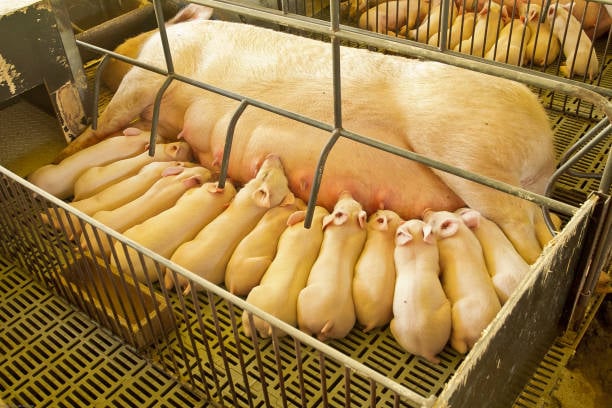
What Is the Optimal PRRSV Status for an Endemic Sow Herd?
PRRSV stable status with no evident PRRSV circulation should be the target for any PRRSV endemic sow herd. This way recurrent reproductive and production losses due to PRRS are avoided. Furthermore, the immune suppression induced by PRRSV is not facilitating secondary infections, increasing antimicrobial use (AMU), or reducing vaccine responses.
This way, outcome and stability of production is maximised towards PRRSV, secondary infections, and other diseases vaccinated for, together with animal health and welfare. Losses and AMU are minimised.
PRRSV Vaccination vs. Live Virus Inoculation: Which Offers Better Protection?
An optimal vaccination strategy is the recommended choice over LVI for immunisation, to get stability in production, viral circulation, and generation of new highly pathogenic PRRSV strains; and to avoid further increase shedding and disease risk of all other pathogens present.

LVI is theoretically favorable due to price, and strain similarity during immunization. Also, it may or may not decrease the time to baseline production; an inconsistent finding. However, several negative points are to be considered. Not only one but several different PRRSV strains are common in farms, and all transferred by LVI, together with other pathogens, like Salmonella, PPV, PCV2, Rota virus, Strep, E. coli and several others. This increases pathogen circulation and disease risk, and increasing time-to-stability = low prevalence status, by ≥12 weeks, and severely increasing the risk of generating new virulent strains on farm, by recombination.
Which PRRSV Vaccination Strategies Help Reduce Viral Circulation and Losses?
The optimal vaccination strategy to control PRRSV circulation and protect against losses is the MLV + INV complementary vaccination scheme (CVS). A heterologous prime-boost vaccination concept.
The conventional PRRSV modified live virus (MLV) vaccines protects very well against the exacts same strain as the one in the vaccine. As soon as the field strain has a few percent genomic difference to the vaccine strain, efficacy in protection reduces rapidly and significantly. Today the field strain to vaccine strain difference is easily 12-15%, hence poor protection. Poor cross-protection and safety in shedding, reversion-to-virulence, and risk of recombination are common hallmarks of conventional PRRSV MLVs.
The killed inactivated (INV) vaccine given to animals never experienced PRRSV infection or MLV vaccination, does not produce a robust protection. However, given to an animal previously infected of MLV vaccinated, it produces a broader and better protection than the MLV-only. Also, it is safe, as it is not live. Post vaccination reaction and efficacy varies with vaccine design.
Complementary vaccination schemes (CVS) are a combination of priming with an MLV and boosting for stronger, broader protection and better viral clearance by an INV PRRSV vaccine. A heterologous prime-boost vaccination concept.
The next-generation CPD attenuated PRRSV2 MLV vaccine, providing significantly better cross-protection and safety than conventional MLVs can still benefit from CVS combination with INV, not the least in an PRRSV1+2 endemic herd.
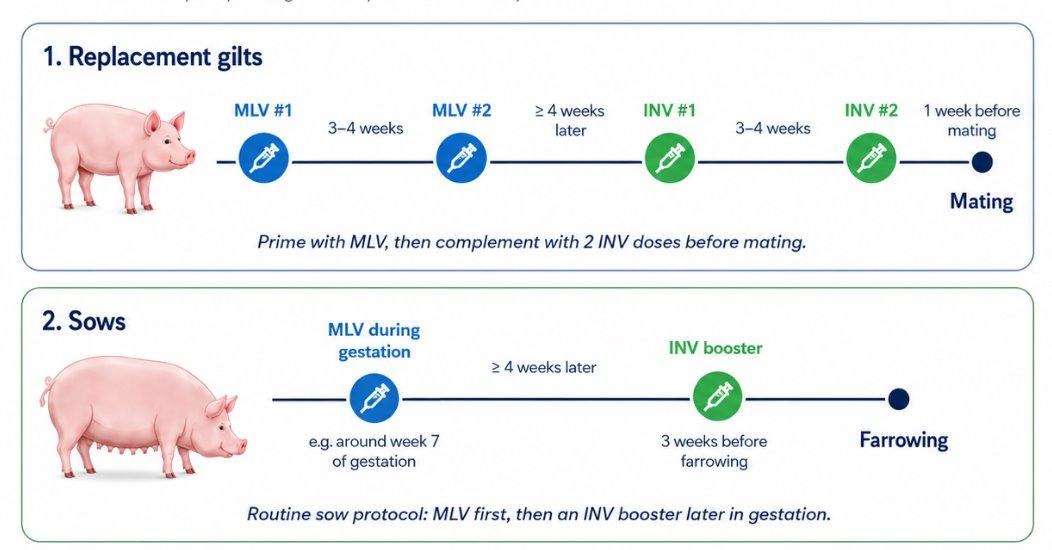
Figure created by AI
The recommended optimal complementary vaccination scheme (CVS) is:
1. Gilts basic vaccinated in quarantine like facility for ≥ 12 weeks- 1st MLV immediately after arrival (W0)
- 2nd MLV 4 weeks later (W4)
- 1st INV 4 weeks later (W8)
- 2nd INV 3 weeks later (W11)
- MLV in 5-7th week of gestation
- INV in the 3rd week prior to farrowing
- In situations of highly virulent strains one dose of INV 2 weeks following MLV is commonly used with significantly better outcome.
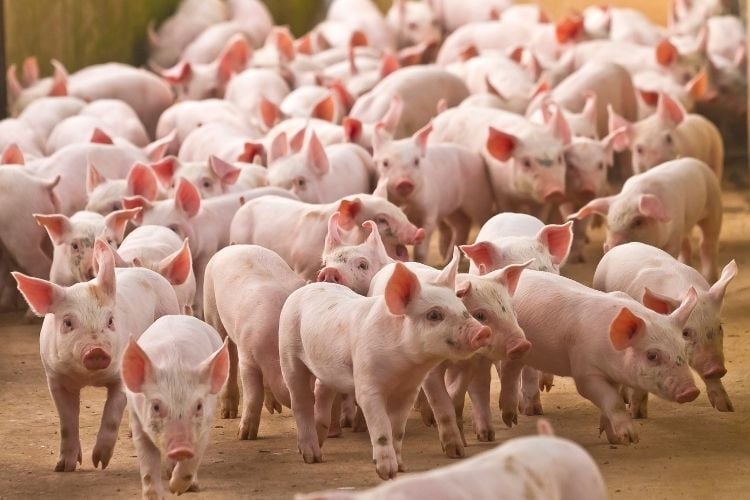
How Can PRRSV Circulation Be Monitored in Endemic Swine Herds?
Sow-herd PRRSV stability is best monitored by tung tip fluids (TTS) of stillborn and suckling piglets tested in two separate pools, to check both sow-stability and biosecurity of the farrowing compartment; grow finishers are monitored by several and pooled oral fluid (OF) samples every 1-4 weeks.
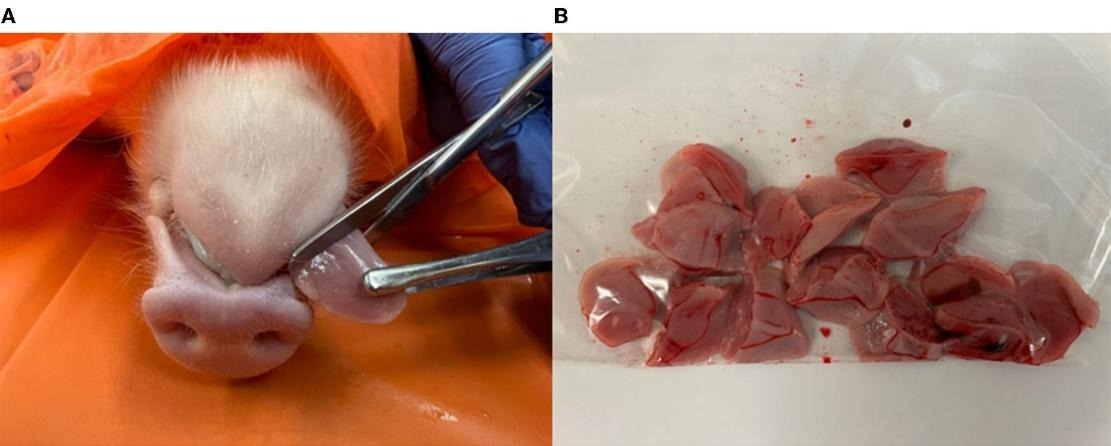
Weekly processing fluid (PF) investigation can be used in the sow herd, but sensitivity is lower, with the risk of anticipating stability on low level circulation, and with no ability to predict PRRSV status at weaning.
Combinations with familial-OF or serum sampling at weaning into processing fluids or TTF on stillborn-only are other options.
The frequency of sampling is every batch/week during outbreaks, ever 2nd- 4th batch/week at baseline production and stability.
Which Internal Biosecurity Measures Are Essential for PRRSV Control?
The key internal biosecurity management routines are gilt introduction and immunisation to cool-down via quarantine like facilities over at least 12 weeks, strict age segregated production and hygienic procedures.
Gilt introduction via quarantine-like facilities for at least 12 weeks, in groups of batches of 4 consecutive weeks to optimally align vaccination age, heat induction and fit into farrowing batches
Strict age segregated production from birth and weaning till slaughter, all-in, all-out with no comingling between batches, and no moving back of older lesser performing pigs to younger.

Strict hygienic procedures: 1) Due diligence in monitoring, treatment ill and euthanasia of non-recovering piglets (McRebel-light), 2) Wash-soap-wash-disinfect-dry out-reheat, for visible cleanliness, removal of biofilm, thorough disinfection, and bringing the room up to pig(let) demands before entering.
The pen has the same infectious risk level: Needle change between pens, scalpel disinfected between piglets; teeth grinded only the very tip, tail cautery cutter sufficiently hot to disinfect and close wound.
What Are the Key Priorities for Long-Term PRRSV Control?
Long-term PRRSV control depends on combining appropriate vaccination, consistent biosecurity, and. In endemic sow herds, producing PRRSV-negative piglets at weaning is an important measure of stability. Control programs should be reviewed regularly using herd performance, laboratory results, circulating viral strains, and veterinary assessment to adapt interventions as conditions change.
FAQs
- What does PRRSV stand for?
PRRSV stands for Porcine Reproductive and Respiratory Syndrome Virus, a pathogen that causes reproductive disorders in breeding pigs and respiratory disease in pigs of different ages. The virus is a major health and economic challenge for the global swine production. - What is the difference between PRRSV-1 and PRRSV-2?
PRRSV-1 and PRRSV-2 are two distinct viral species associated with porcine reproductive and respiratory syndrome. They differ genetically and antigenically both between and inside the two PRRSV types,, which strongly influences the protection provided by different vaccines, and can influence diagnostic approaches. - What are the main economic consequences of PRRSV infection?
PRRSV can cause reproductive losses, increased piglet mortality, respiratory disease, poorer production performance, and immunosuppression allowing for secondary infections and reduced response to vaccines given during PRRSV impact. Additional costs may arise from veterinary treatment, diagnostic testing, biosecurity measures, and disease-control interventions. - How can producers tell whether PRRSV control measures are working?
Producers can evaluate PRRSV control through regular diagnostic surveillance and production indicators, including reproductive performance, piglet survival, and clinical disease. Trends over time help veterinarians assess whether a herd is maintaining or moving toward PRRSV stability.
References
- Díaz I, Gimeno M, Callén A, et al. Comparison of different vaccination schedules for sustaining the immune response against porcine reproductive and respiratory syndrome virus. Vet J. 2013 Aug;197(2):438-44. doi:10.1016/j.tvjl.2013.02.008
- Martín-Valls GE, Mortensen P, Clilvert H, et al. The use of a whole inactivated PRRS virus vaccine administered in sows and impact on maternally derived immunity and timing of PRRS virus infection in piglets. Vet Rec Open. 2022 Apr 5;9(1):e34. doi:10.1002/vro2.34
- Mohammed, M.Z.; Linhares, D.C.L.; Zeller, M.A et al. Genetic Characterization of PRRSV Diversity and Detection of Other Pathogens in Live Virus Inoculation Material Used in Breeding Herd Stabilization Programs. Microorganisms 2026, 14, 1207. doi:10.3390/microorganisms14061207
- Trevisan G, Zeller M, Li G, et al. Implementing a user-friendly format to analyze PRRSV next-generation sequencing results and associating breeding herd production performance with number of PRRSV strains and recombination events. Transbound Emerg Dis. 2022 Sep;69(5):e2214-e2229. doi:10.1111/tbed.14560
- Stepanova K, Toman M, Sinkorova J et al. Modified live vaccine strains of porcine reproductive and respiratory syndrome virus cause immune system dysregulation similar to wild strains. Front Immunol. 2024 Jan 12;14:1292381. doi: 10.3389/fimmu.2023.1292381
- Baliellas J, Novell E, Enric-Tarancón V, et al. Porcine reproductive and respiratory syndrome surveillance in breeding herds and nurseries using tongue tips from dead animals. Veterinary Sciences. 2021;8:259. doi:10.3390/vetsci8110259.
- Machado IF, Magalhães ES, Poeta Silva APS, et al. Porcine reproductive and respiratory syndrome virus RNA detection in tongue tips from dead animals. Frontiers in Veterinary Science. 2022;9:993442. doi:10.3389/fvets.2022.993442.
- Dürlinger S, et al. Detection of PRRSV-1 in tongue fluids under experimental and field conditions and comparison of different sampling material for PRRSV sow herd monitoring. Porcine Health Management. 2024;10. doi:10.1186/s40813-024-00370-0.
- Paploski IAD, Kikuti M, Yang X, et al. Optimizing PRRSV detection: the impact of sample processing and testing strategies on tongue tips. Pathogens. 2025;14:1028. doi:10.3390/pathogens14101028.
- López WA, Angulo J, Zimmerman JJ, Linhares DCL. Porcine reproductive and respiratory syndrome monitoring in breeding herds using processing fluids. Journal of Swine Health and Production. 2018;26:146-150.
- Almeida MN, Corzo CA, Zimmerman JJ, Linhares DCL. Longitudinal piglet sampling in commercial sow farms highlights the challenge of PRRSV detection. Porcine Health Management. 2021;7:24. doi:10.1186/s40813-021-00210-5.
- Almeida MN, Zhang M, Zimmerman JJ, Holtkamp DJ, Linhares DCL. Finding PRRSV in sow herds: family oral fluids vs. serum samples from due-to-wean pigs. Preventive Veterinary Medicine. 2021;193:105397. doi:10.1016/j.prevetmed.2021.105397.
- Osemeke OH, de Freitas Costa E, Almeida MN, et al. Effect of pooling family oral fluids on the probability of PRRSV RNA detection by RT-rtPCR. Preventive Veterinary Medicine. 2022;206:105701. doi:10.1016/j.prevetmed.2022.105701.