23 September 2026
What Is Heat Stress and How Does It Affect Pigs?
Heat stress is a state of physiological strain when animals are exposed to high ambient temperatures, humidity, low wind speed and high solar radiation and are unable to regulate their body temperature effectively [3].
Pigs are homeothermic animals, maintaining a relatively constant body temperature of around 38 – 39 °C. However, they have a limited capacity to dissipate heat because they have very few functional sweat glands and cannot rely effectively on sweating for evaporative cooling [4]. Their relatively large body mass and subcutaneous fat further reduce heat dissipation, particularly in heavier pigs and sows.
When environmental conditions become too warm, pigs increase respiratory rate and may reduce feed intake and activity to limit heat production. If these responses are insufficient, heat stress can lead to behavioural changes, reduced growth and reproductive performance, impaired welfare and, in severe cases, mortality, piglets being particularly sensitive [1,2].
Maintaining suitable environmental conditions is therefore important to help pigs remain within their thermoneutral zone (TNZ). The TNZ is the range of environmental temperatures in which pigs can maintain a stable body temperature with relatively constant metabolic heat production. Within this range, there is a narrower thermal comfort zone, where conditions are optimal, triggering little additional physiological or behavioural response. As temperatures approach or exceed the upper limits of these zones, thermoregulatory responses increase and the risk of heat stress rises [5].
Table 1 indicates the upper limits of the thermal comfort zone and TNZ for the different pig categories. Thermal requirements also depend on factors such as housing conditions, for example, systems with bedding or well-insulated floors may have lower limits.
Table 1 – Upper limit of the comfort zone and TNZ (in ºC) for different pig categories. (Sterrenburg and Van Ouwerkerk, 1990 cited by Vermeer and Aarnink, 2023).
|
Swine Category |
Upper limit Comfort Zone |
Upper Limit Thermo-Neutral Zone |
|
Piglets 8 Kg |
31 |
35 |
|
Piglets 20 Kg |
26 |
30 |
|
Grower 30kg |
24 |
28 |
|
Finisher > 60Kg |
20 |
25 |
|
Empty Sow |
25 |
29 |
|
Pregnant Sow |
23 |
26 |
|
Lactating Sow |
18 |
21 |
Source: [6]
How does the Temperature-Humidity Index (THI) Work for Pigs?
THI is a useful and practical tool for farmers to monitor environmental heat load. Several formulas are available, including general equations such as the one originally created by Thom (1958), as well as equations developed or adapted for livestock and pigs [7].
The formula, proposed by Thom (1959), which is the most commonly used is:
THI =0.8 x T + RH x (T-14.4) + 46.4
Where:
- T is the ambient temperature in degrees Celsius
- RH is the relative humidity expressed as a decimal proportion (e.g., 75% RH becomes 0.75). [7]
The resulting THI provides an indication of the level of heat stress. For the formula presented above, the thresholds in Table 2 are based on those defined by Thom (1959), as reported by Chavez-Flores et al. 2026 [7].
Table 2 – Indicative THI ranges and corresponding levels of heat stress in pigs.
|
THI |
|
|
Suitable |
<74 |
|
Mild |
≥ 74 – < 78 |
|
Moderate |
≥ 78 – < 82 |
|
Severe |
≥ 82 |
Source: [7]
However, the thresholds used to classify heat stress can vary according to the equation, animal category and environmental conditions. As an example, Figure 1 shows THI values for weaners weighing approximately 15 kg, using a different THI formula, as described by Vermeer and Aarnink, 2023 [6].
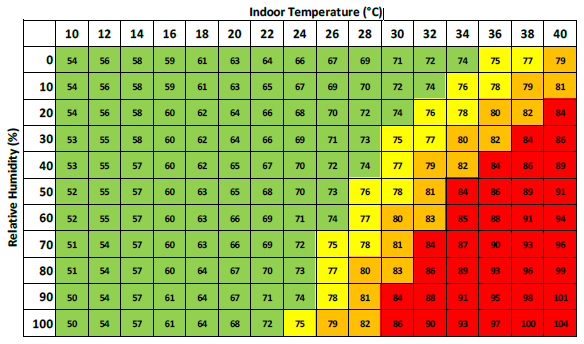
Figure 1 – Example of THI for weaners of approximately 15 kg, where green is the thermoneutral zone, yellow represents early risk of heat stress, orange represents moderate risk of heat stress and red represents severe risk of heat stress.
Source: [6]
Overall, THI is a useful and practical tool for monitoring the environmental conditions on farms and identifying periods when pigs may be at greater risk of heat stress.
How Can Farmers Prevent and Reduce Heat Stress in Pigs?
There are several strategies that can be used to prevent and control heat stress in pigs. Planning several days in advance and checking weather forecasts for temperature and humidity can help farmers anticipate periods of high heat load. Regularly monitoring temperature and humidity inside the facilities and comparing these values with THI can also help identify whether housing conditions are adequate.
Pig behaviour should also be regularly monitored, including activity, respiration rate, feed and water intake, pen fouling (pigs usually excrete in the same locations, if the excretions are scattered, can be a sign of stress) and lying patterns [6].
Below are some examples of strategies that can be implemented, although other measures may also be appropriate depending on the farm conditions:
- Reduce feed intake before heat stress occurs. Although this may negatively affect growth performance, it can reduce heat production and help decrease the risk of mortality during severe heat stress;
- Adjust the fibre, energy, protein and fat content of the diet to reduce heat production;
- Avoid unnecessary disturbance of animals during the hottest periods and adjust feeding schedules;
- Maximize ventilation and air velocity, and ensure that ventilators, air ducts, scrubbers and inlets are clean to reduce air resistance;
- Ensure adequate access to fresh, clean and cool water, and regularly check drinker flow rates;
- Use evaporative cooling, such as water spraying in air inlets, showers or sprinklers, when appropriate;
- Maximize space allocation per pig to facilitate heat dissipation;
- Make sure emergency systems are functional in case of ventilation failure or other technical problems [1, 6].
What are the Key Take-Home Messages about Swine Influenza?
Heat stress is a major challenge for pig welfare, performance and farm profitability. Because pigs have a limited capacity for evaporative cooling, they are particularly vulnerable to high temperatures, especially when humidity is also high. THI provides a simple way to monitor environmental heat load but should be used together with animal-based indicators and knowledge of the specific pig category. Early monitoring and appropriate ventilation, water supply, feeding and cooling strategies can help reduce the effects of heat stress and maintain animal welfare and production performance.
Frequently asked questions about swine influenza
What THI value indicates heat stress in pigs?
Using the equation presented in this article, mild heat stress begins at a THI of 74, moderate heat stress at 78 and severe heat stress at 82. However, thresholds vary according to the equation, pig category and environmental conditions.
Does humidity increase heat-stress risk in pigs?
Yes. High relative humidity can increase environmental heat load and make it harder for pigs to dissipate heat effectively, which is why THI evaluates temperature together with humidity.
Can THI alone determine whether pigs are experiencing heat stress?
No. THI should be combined with animal-based indicators such as respiration, activity, feed and water intake, lying behaviour and other signs of thermal stress.
Why can THI thresholds differ between pigs?
THI thresholds can vary with the calculation used, animal category and environmental conditions. Pig size, physiological stage and housing conditions also influence thermal requirements.
References
[1] Jayalakshmi, K., & Sasikala, M. (2017). Heat stress in swine—A review. International Journal of Farm Sciences, 7, 7–10.
[2] de Oliveira, M. J. K., Polycarpo, G. V., Andretta, I., Melo, A. D. B., Marçal, D. A., Létourneau-Montminy, M. P., & Hauschild, L. (2024). Effect of constant and cyclic heat stress on growth performance, water intake, and physiological responses in pigs: A meta-analysis. Animal Feed Science and Technology, 309, 115904. https://doi.org/10.1016/j.anifeedsci.2024.115904
[3] Ondruska, L., Rafay, J., Okab, A. B., Ayoub, M. A., Al-Haidary, A. A., Samara, E. M., Parkányi, V., Chrastinová, L., Jurčík, R., Massányi, P., Lukáč, N., & Supuka, P. (2011). Influence of elevated ambient temperature upon some physiological measurements of New Zealand white rabbit. Veterinarni medicina, 56(4), 180–186.
[4] Collier, R. J., & Gebremedhin, K. G. (2015). Thermal biology of domestic animals. Annual Review of Animal Biosciences, 3, 513–532. https://doi.org/10.1146/annurev-animal-022114-110659
[5] European Food Safety Authority (EFSA), AHAW Panel. (2022). Welfare of pigs during transport. EFSA Journal, 20(9), 7445. https://doi.org/10.2903/j.efsa.2022.7445
[6] Vermeer, H. M., & Aarnink, A. J. A. (2023). Review on heat stress in pigs on farm. EURCAW-Pigs. https://doi.org/10.5281/zenodo.7620726
[7] Chavez-Flores, M., Villa-Mancera, A., Robles-Robles, J. M., Olivares-Pérez, J., Olmedo-Juárez, A., Córdova-Izquierdo, A., González-Garduño, R., Ponce-Covarrubias, J. L., Rivero-Perez, N., Patricio, F., Muñoz-Cuautle, A., & Ortega-Vargas, S. (2026). Heat Stress Assessment Using Multiple Thermal-Comfort Indices and Its Impact on the Reproductive Performance of Sows and Their Offspring in a Temperate Climate. Veterinary Sciences, 13(3), 270. https://doi.org/10.3390/vetsci13030270
