22 September 2026
What are the symptoms of Swine Influenza in pigs?
Swine influenza symptoms can include high fever, coughing, dyspnoea, sneezing, nasal discharge, loss of appetite and lethargy. In endemic infections, signs can be less obvious and may include intermittent coughing, inconsistent fever, poor growth, reproductive problems and increased antibiotic use.
A sharp fever spike is typically the earliest sign, and the one most often overlooked — by the time dyspnoea, coughing, sneezing, nasal discharge, anorexia and lethargy appear, the temperature may already be back to normal.
Lung lesions can closely resemble those attributed to Mycoplasma hyopneumoniae, so confirm the cause in the laboratory rather than on gross pathology alone.
The endemic picture is the one most often mislabelled. Because swine influenza A virus (swIAV) is a driver of the porcine respiratory disease complex (PRDC), what you see is usually the consequence rather than the virus itself: swIAV damages the respiratory epithelium and paves the way for PRRSV, PCV2, Streptococcus suis, Actinobacillus pleuropneumoniae, M. hyopneumoniae and Glaesserella parasuis. Clinical signs therefore peak days after the influenza infection that started them.
In sows, endemic infection is linked to poorer reproductive performance: across 137 sow farms, vaccinating H1pdmN1-positive herds cut return to oestrus from 13.52% to 10.18% and added roughly one weaned piglet per sow per year (Gumbert et al., 2020). In growing pigs, batches that were influenza-positive at weaning showed a median relative increase in post-weaning mortality of 13% (Alvarez et al., 2015).
| Acute infection | high fever, coughing, dyspnoea, sudden inappetence. |
| Endemic infection | intermittent coughing, inconsistent fever, poor-performing groups, reproductive issues and increased antibiotic use. |
Why does swine influenza diagnosis sometimes come back negative
A swine influenza PCR test can come back negative when pigs are sampled too late. swIAV is cleared from the respiratory tract within roughly 7–9 days of infection, so pigs showing respiratory signs may already have stopped shedding the virus when they are tested.
The cornerstone of swine influenza diagnosis is RT-PCR on nasal swabs. Where the viral load is high enough, the laboratory can subtype the virus using HA- and NA-specific RT-PCR, which tells you whether you face H1av, H1hu, H1pdm or H3 lineages.
It is important to highlight two factors: firstly, several subtypes can co-circulate on one farm and secondly, swIAV is also detected year-round, so there is no season in which you can stop looking.
Also, it is critical that samples (nasal swabs and oral fluids) are shipped in cooling conditions and combined with stabilizers, such as viral media, to ensure they arrive at the laboratory in optimal condition (Grau et al, 2024).
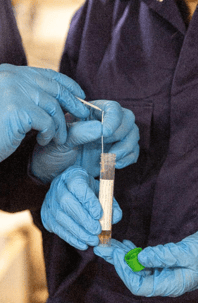 Swine influenza sampling as part of diagnostic testing and disease surveillance in pigs.
Serology helps, within limits. ELISA shows exposure to influenza A in general; haemagglutination inhibition (HI) gives subtype-specific evidence. Maternally derived antibodies (MDA) are the main obstacle — piglets may not seroconvert measurably even when infected. Avoid single serum samples in nursery pigs; use paired sera in gilts and sows.
There is a second complication on vaccinated units: antibodies from natural exposure cannot be distinguished from those raised by a swine influenza vaccine, and antigenic variability between lineages causes cross-reactions.
How should you sample pigs for swine influenza on farm?
Take 10 nasal swabs from each of three age groups minimum — suckling piglets, weaners and mid-to-end nursery pigs — tested in pools of five, and add group samples such as oral fluids where prevalence is likely to be low. Sample across age groups, not only pigs that look sick.
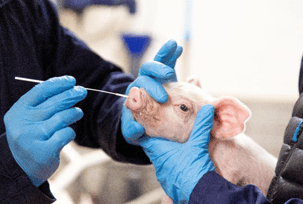
Nasal swab collection from a piglet for swine influenza diagnosis and surveillance.
This sampling approach is supported by a Ceva cross-sectional study of 131 farms in 12 European countries (Lillie-Jaschniski et al., 2022), which detected swIAV on 78.6% of farms.
- Weaners were the best single age group — about 1.5 times more likely to be positive than nursery pigs (p = 0.048) — despite clinical signs being far more obvious in the nursery.
- Coughing pigs are a poor guide elsewhere. Among suckling piglets, more positives came from healthy-looking pigs (7.2% of all samples) than from pigs with signs (4.3%). This can be due to the clinical protection provided by MDA. Therefore the importance of also sampling apparently healthy pigs.
Thirty pigs assumes a 15% within-herd prevalence; below that, add swabs or group sampling.
For characterisation, nasal swabs still win. The proportion of positives reaching Ct < 32, and so usable for subtyping, was 66.7% for nasal swabs, 52.9% for oral fluids, 20% for udder skin wipes and just 2.8% for dust wipes (Stadler et al., 2024).
It is not uncommon to find different subtypes in different age groups on the same farm, so one specimen from one group gives a partial picture.
How do you choose and use a swine influenza vaccine?
Base the choice on the strains your own sampling identifies. Inactivated swine influenza vaccines do not produce sterile immunity, so the aim is to reduce shedding and reduce clinical signs, not to keep the virus out.
This is why subtyping matters. A mismatch between vaccine lineage and the strain on your farm costs you protection.
Mass vaccination of the whole sow herd at fixed intervals targets the reservoir, lowering the virus load sows pass to each successive batch.
MDA reduces clinical signs but often does not prevent infection or shedding (Deblanc et al, 2018). Clinically protected suckling piglets carry the virus into the nursery, so cutting infection pressure in the sow herd is more effective than shielding piglets by maximising MDA alone.
Vaccination is one half of the job. Quarantine and vaccinate incoming gilts (Ryt-Hansen et al, 2022), which shed heavily on first infection and can seed the farrowing unit; manage colostrum intake; and take internal biosecurity seriously. Swine influenza travels on hands, overalls, carts and instruments, so hand washing, glove changes and clean overalls after high-risk tasks all matter. Minimise cross-fostering and nurse sows (Garrido-Mantilla et al, 2021), which spread the virus between litters.
What are the Key Take-Home Messages about Swine Influenza?
- Sample at the right time: late sampling is a major cause of negative swine influenza results.
- Sample across age groups: include suckling piglets, weaners and nursery pigs rather than relying only on visibly sick animals.
- Characterise circulating strains: combine appropriate sampling with subtyping to understand the farm-specific influenza picture.
- Combine vaccination and biosecurity: long-term control depends on diagnosis, appropriate vaccination and internal biosecurity working together.
Frequently asked questions about swine influenza
Can humans transmit Swine Influenza viruses to pigs?
Yes. Transmission runs in both directions, and farm workers are a recognised route of introduction into pig units. The 2009 pandemic H1N1 strain entered swine populations worldwide from humans and then reassorted with endemic strains. Staff with influenza-like illness should stay out of the pig buildings.
Do antibiotics help against swine influenza?
No. Antibiotics do not treat the swine influenza virus, but they may be used to treat secondary bacterial infections associated with influenza.Controlling the underlying influenza infection is what reduces antibiotic use over time.
Can swine influenza be eliminated from a herd?
Elimination is difficult and rarely the realistic goal on a commercial farm, because the virus persists in successive batches of susceptible piglets and can be reintroduced by people, gilts or air. Most herds aim to reduce circulation and clinical impact rather than achieve freedom.
Is swine influenza seasonal in pigs?
No. Unlike human influenza, swine influenza A virus can be detected in pigs throughout the year.
References
Alvarez J, Sarradell J, Kerkaert B, Bandyopadhyay D, Torremorell M, Morrison R, Perez A. Association of the presence of influenza A virus and porcine reproductive and respiratory syndrome virus in sow farms with post-weaning mortality. Preventive Veterinary Medicine. 2015;121(3–4):240–5.
Deblanc, C., Hervé, S., Gorin, S., Cador, C., Andraud, M., Quéguiner, S., Barbier, N., Paboeuf F., Rose N. & Simon, G. (2018). Maternally-derived antibodies do not inhibit swine influenza virus replication in piglets but decrease excreted virus infectivity and impair post-infectious immune responses. Veterinary microbiology, 216, 142-152.
Garrido-Mantilla J, Alvarez J, Culhane M, Nirmala J, Cano JP, Torremorell M. Comparison of individual, group and environmental sampling strategies to conduct influenza surveillance in pigs. BMC Veterinary Research. 2019;15:61.
Garrido-Mantilla, J., Sanhueza, J., Alvarez, J., Culhane, M. R., Davies, P., Allerson, M. W., & Torremorell, M. (2021). Impact of nurse sows on influenza A virus transmission in pigs under field conditions. Preventive Veterinary Medicine, 188, 105257.
Grau, K., Lillie-Jaschniski, K., Graaf-Rau, A. et al. Effect of stabilizers on the detection of swine influenza A virus (swIAV) in spiked oral fluids over time. Porc Health Manag 10, 49 (2024). https://doi.org/10.1186/s40813-024-00386-6
Gumbert S, Froehlich S, Rieger A, Stadler J, Ritzmann M, Zoels S. Reproductive performance of pandemic influenza A virus infected sow herds before and after implementation of a vaccine against the influenza A (H1N1) pdm09 virus. Porcine Health Management. 2020;6:4.
Henritzi D, Petric PP, Lewis NS, Graaf A, Pessia A, Starick E, Breithaupt A, Strebelow G, Luttermann C, Parker LMK, et al. Surveillance of European domestic pig populations identifies an emerging reservoir of potentially zoonotic swine influenza A viruses. Cell Host & Microbe. 2020;28(4):614–627.e6.
Lillie-Jaschniski K, Lisgara M, Pileri E, Jardin A, Velazquez E, Köchling M, Albin M, Casanovas C, Skampardonis V, Stadler J. A New Sampling Approach for the Detection of Swine Influenza A Virus on European Sow Farms. Veterinary Sciences. 2022;9(7):338.
Ryt-Hansen, P., Nielsen, H. G., Sørensen, S. S., Larsen, I., Kristensen, C. S., & Larsen, L. E. (2022). The role of gilts in transmission dynamics of swine influenza virus and impacts of vaccination strategies and quarantine management. Porcine health management, 8(1), 19.
Stadler J, Zwickl S, Gumbert S, Ritzmann M, Lillie-Jaschniski K, Harder T, Graaf-Rau A, Skampardonis V, Eddicks M. Influenza surveillance in pigs: balancing act between broad diagnostic coverage and specific virus characterization. Porcine Health Management.
